
Everything on the table
MythForge is one app for the whole night: the NPC you improvise at the door, the fight it turns into, the map it happens on, and the secret your players still haven’t found. Here’s all of it, in detail.
The Forge
Generate NPCs faster than your players can derail the plot
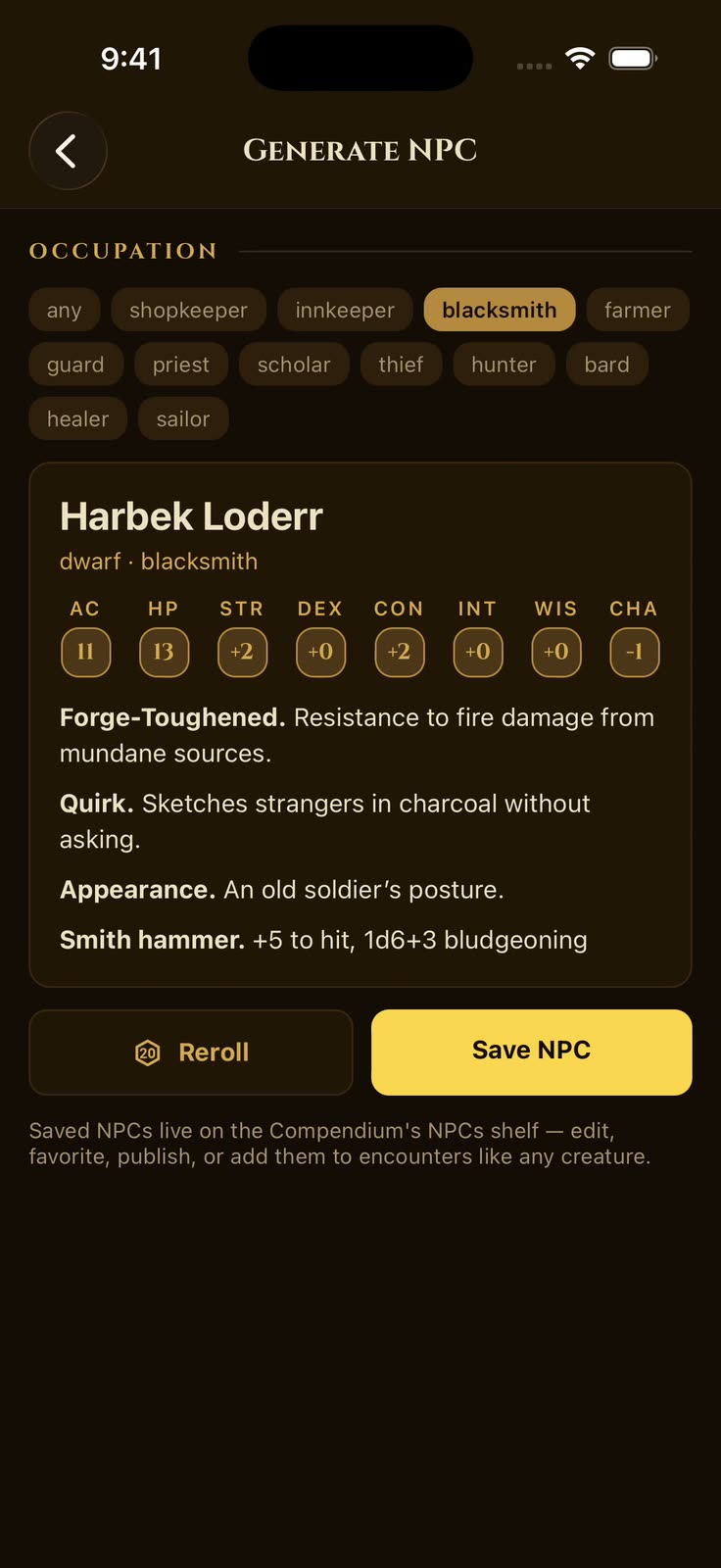
Every NPC comes out playable, not a sketch. Ability scores, proficiency, hit points, AC, and an attack with its to-hit and damage already worked out and normalized to 5e, so a level-12 half-elf bard has the numbers a level-12 half-elf bard should have.
Pin what you know and roll the rest. If the scene needs an innkeeper, pin the occupation and reroll until the name and the quirk land; everything you pinned survives the reroll. Nothing is saved until you say so, so you can spin the wheel at the table without filling your compendium with strangers.
Every NPC carries something to play, not just something to stat: a quirk, a mannerism, a reason to care. The blacksmith who won’t meet your eye is a scene. A block of numbers isn’t.
The Bestiary
Every SRD monster in your pocket, and every one of yours
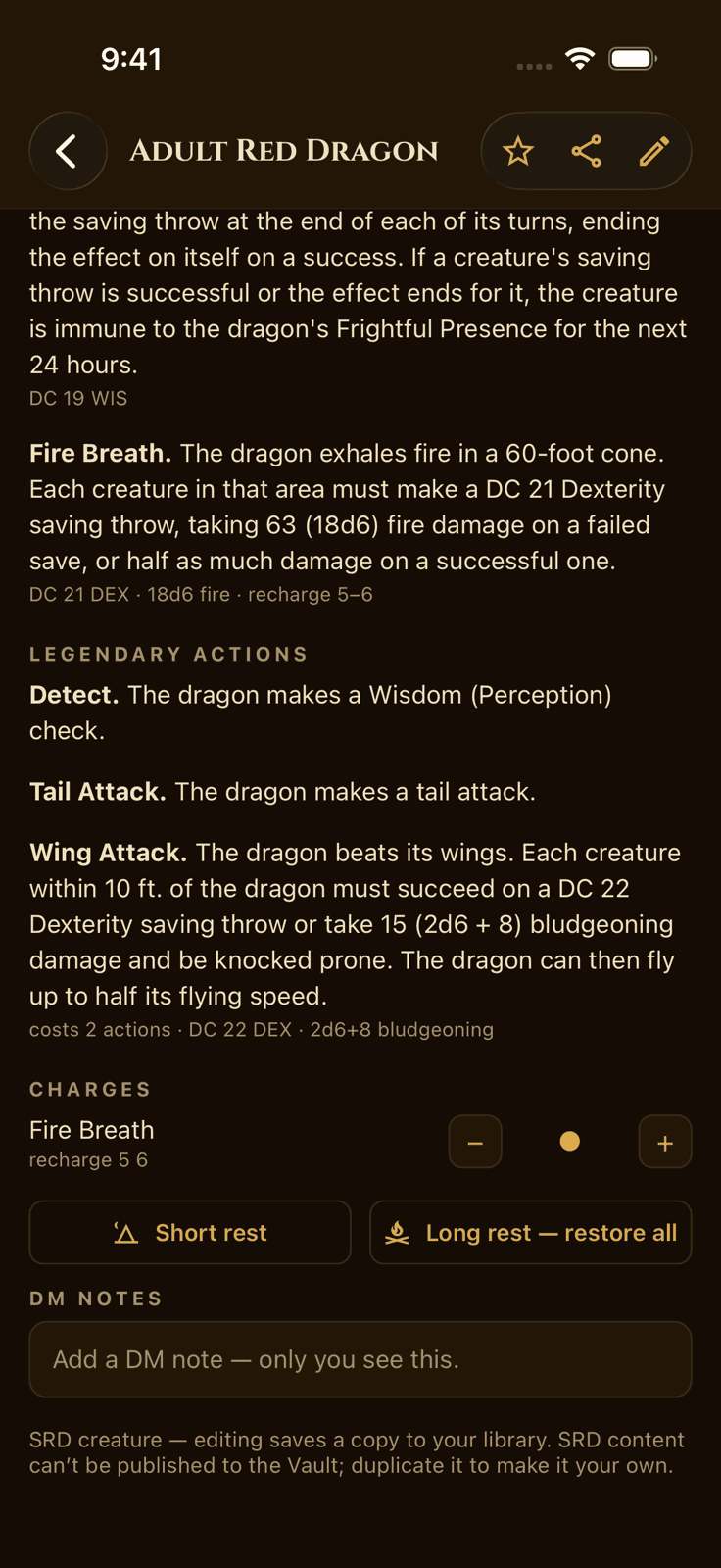
The whole SRD, on the device, with no connection. Not ability scores and a wish but the full block: actions, legendary actions, reactions, saving throws, resistances, immunities, senses, and spellcasting. The basement with no bars is exactly where you need it most, so that is where it works.
Facets, not a search box you have to outsmart. Narrow beasts by type, size, challenge rating, favourites, or source; NPCs by race and occupation; spells by level, school, and class; items by category and rarity. Pick as many as you like and the shelf narrows as you go.
Your homebrew sits on the same shelves as the SRD, because at the table there is no difference. Build a creature in the editor, photograph a paper stat block and let the scanner read it, or paste in Mythcode someone shared. All three land as fully playable entries.
At the Table
Initiative, hit points, and conditions without the paperwork
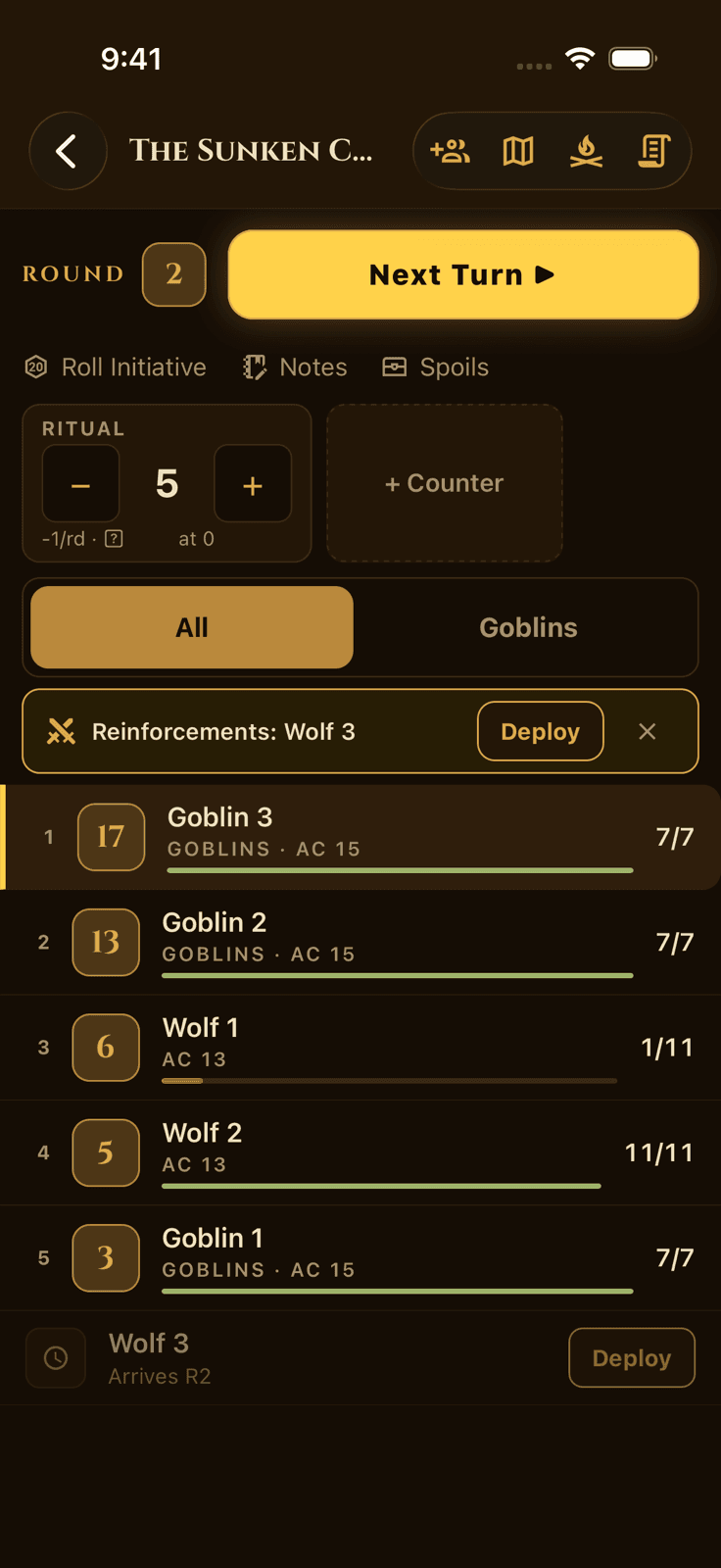
Mobs behave like mobs. Add six goblins as one group and roll them on a single initiative, or roll each one. Your call, per group, per fight. Turn order stays sorted as hit points move and creatures drop.
The bookkeeping that eats a round: one-tap damage and healing, conditions that ride on the combatant, charges and recharges, spell slots, and legendary actions that reset when they should.
Named counters are the trick nobody else has. A ritual three rounds from completion, an alarm, a collapsing bridge: give it a name and a countdown, and it ticks itself each round and throws a banner the moment it matters. You stop holding the clock in your head.
Reinforcements can wait in the wings. Stage them to arrive on round four; when the banner goes up, one tap deploys them on a shared initiative. No scrambling to add six wolves while everyone watches.
When it’s over, the Spoils screen splits XP by who actually earned it, and loot carries investigation DCs so the search is a scene rather than a list.
The War Table
Lay the fight out on the map
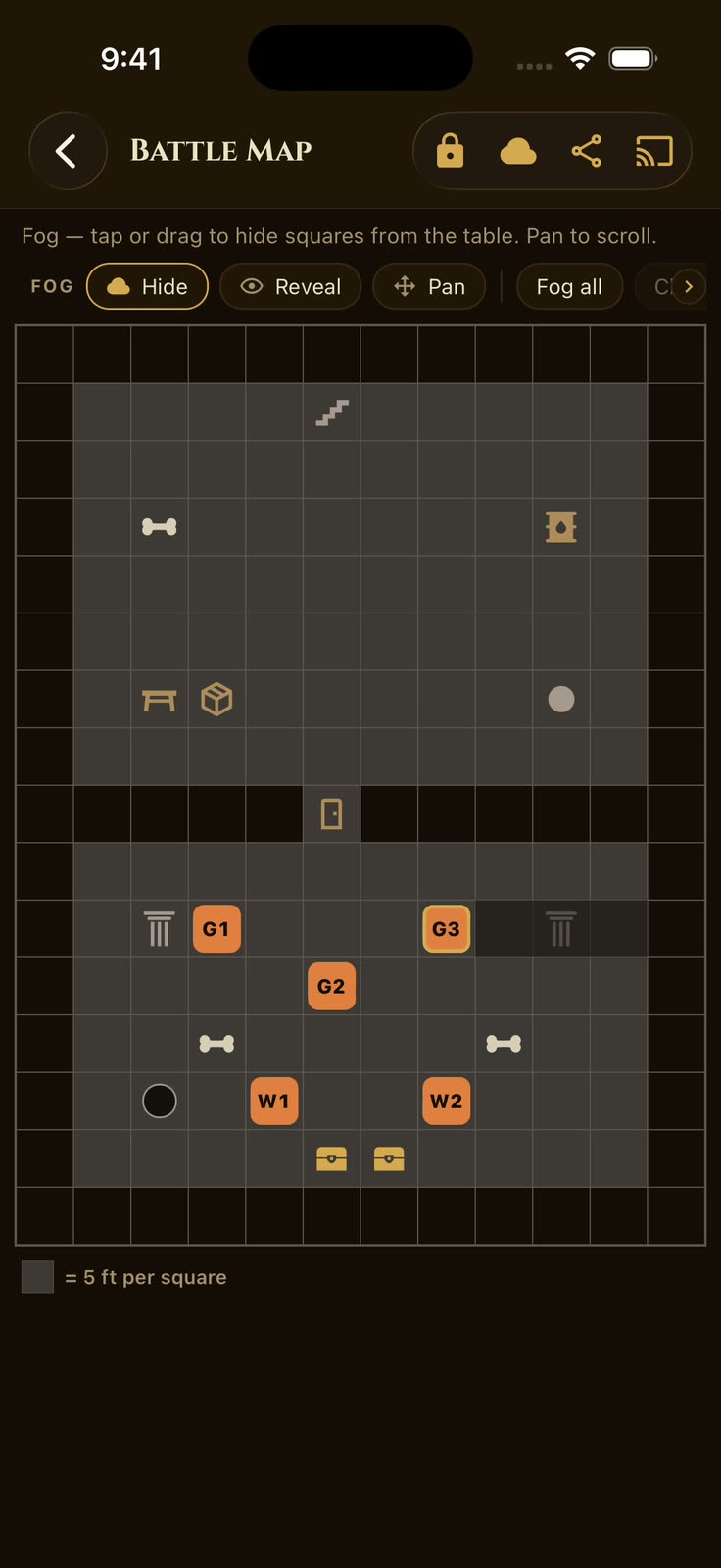
Build the room as you describe it. Sketch walls, trees, water, rubble, and treasure onto a five-foot grid; drop tokens that wear their class icons, and move them without losing the turn order underneath.
Aim before you commit. Pick a spell and MythForge lights every square inside its range, so “does the cone catch the archer?” is answered by looking instead of arguing.
Cast the board to the table. Your players open a link in any browser (no app, no account, no install) and see the same map, icon for icon. Point at a square and your marker flares on every screen at once.
Fog of war that actually hides things. Paint fog over the rooms they haven’t found and lift it square by square as they explore. A fogged square isn’t dimmed on their end: it is never sent there, and neither is the monster standing on it. Nothing to leak, because nothing left the device.
A monster half in the mist shows exactly the half they can see, and no more: not its size, not where it’s anchored. It still holds its place in initiative, so the party knows something is out there, just not where.
The Dice
Roll anything a tabletop can throw at you
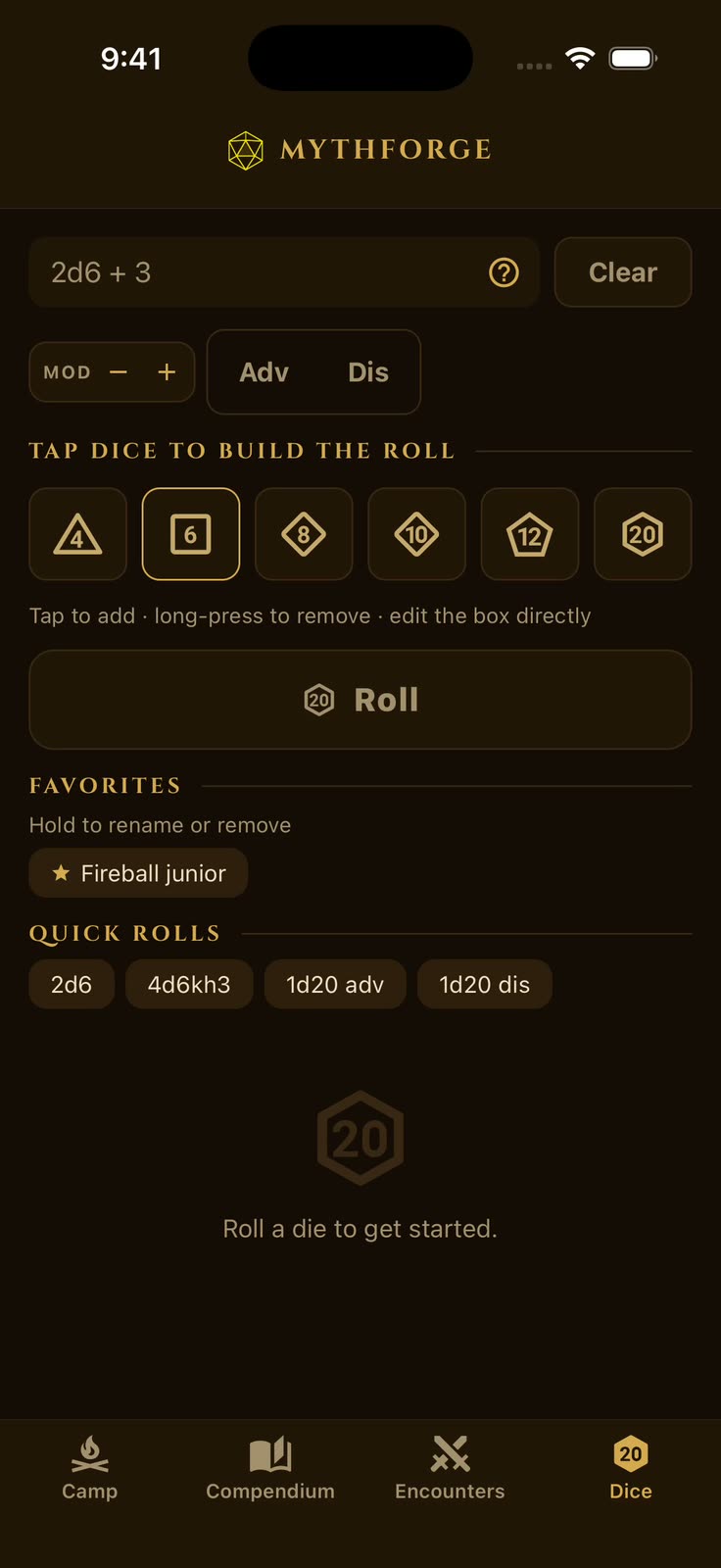
Write it or tap it. Type real notation (4d6kh3, 2d20kl1, 1d20+5) or tap dice in the tray and let MythForge write the notation for you. Both end in the same place, so nobody has to learn a syntax to roll a d20.
Advantage and disadvantage are buttons, not arithmetic. Keep-highest and keep-lowest show their working: every die that landed, and which ones counted.
Favourites remember the rolls your table makes every session, and quick-roll chips cover the classics. A natural twenty gets the celebration it deserves.
The Journal
Campaign notes that keep your secrets
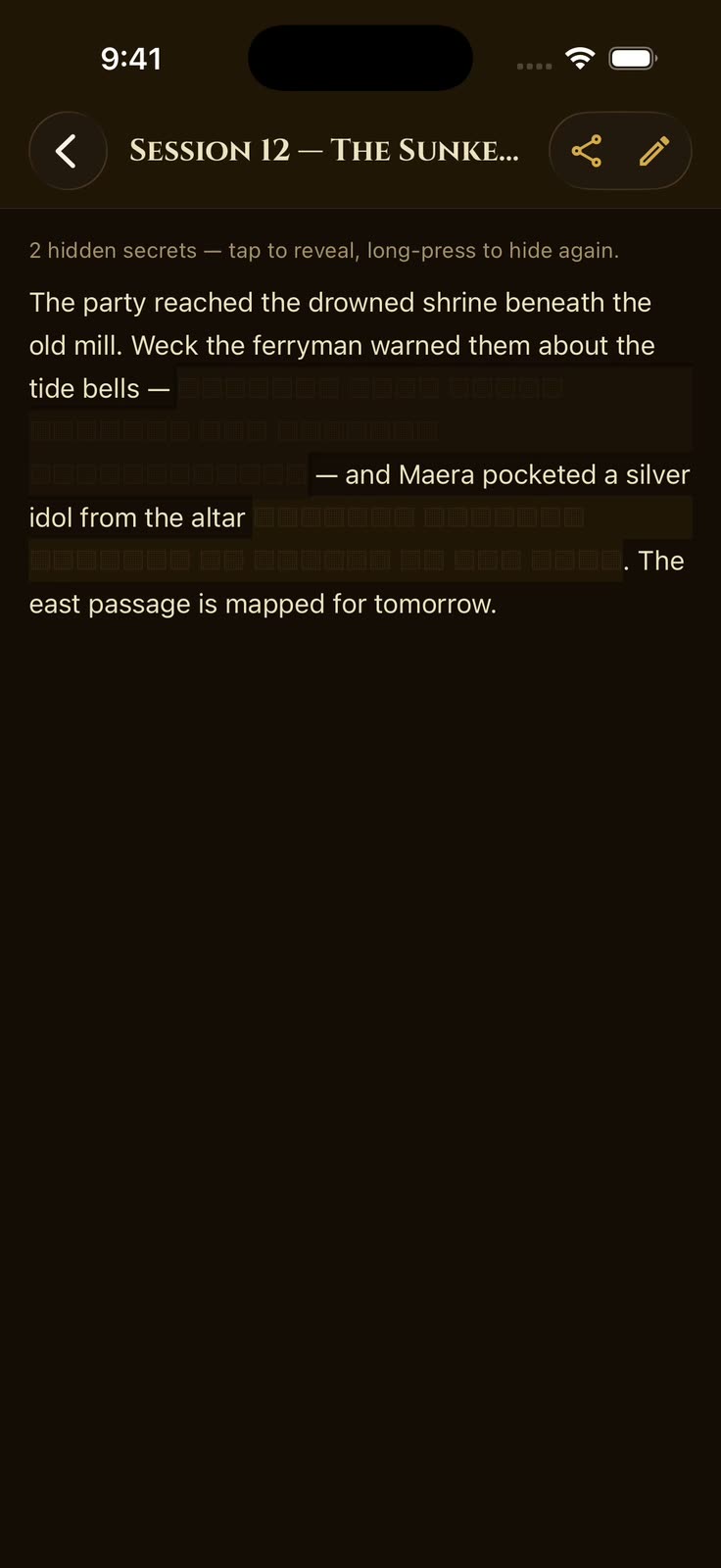
One recap, two readers. Write the session once and wrap the parts they shouldn’t see yet in a hidden block. Players get the shareable version; you keep the truth, in the same document, so there is no second file to keep in sync and no wrong file to hand over.
A secret reveals with a tap and hides again with a long-press. The villain’s name stays yours until the moment it lands, and then it goes straight back under wraps for the next person reading over your shoulder.
Notes belong to the campaign, so last session’s cliffhanger is one tap from tonight’s encounter rather than in a different app entirely.
The Vault
Share your creations with Game Masters everywhere
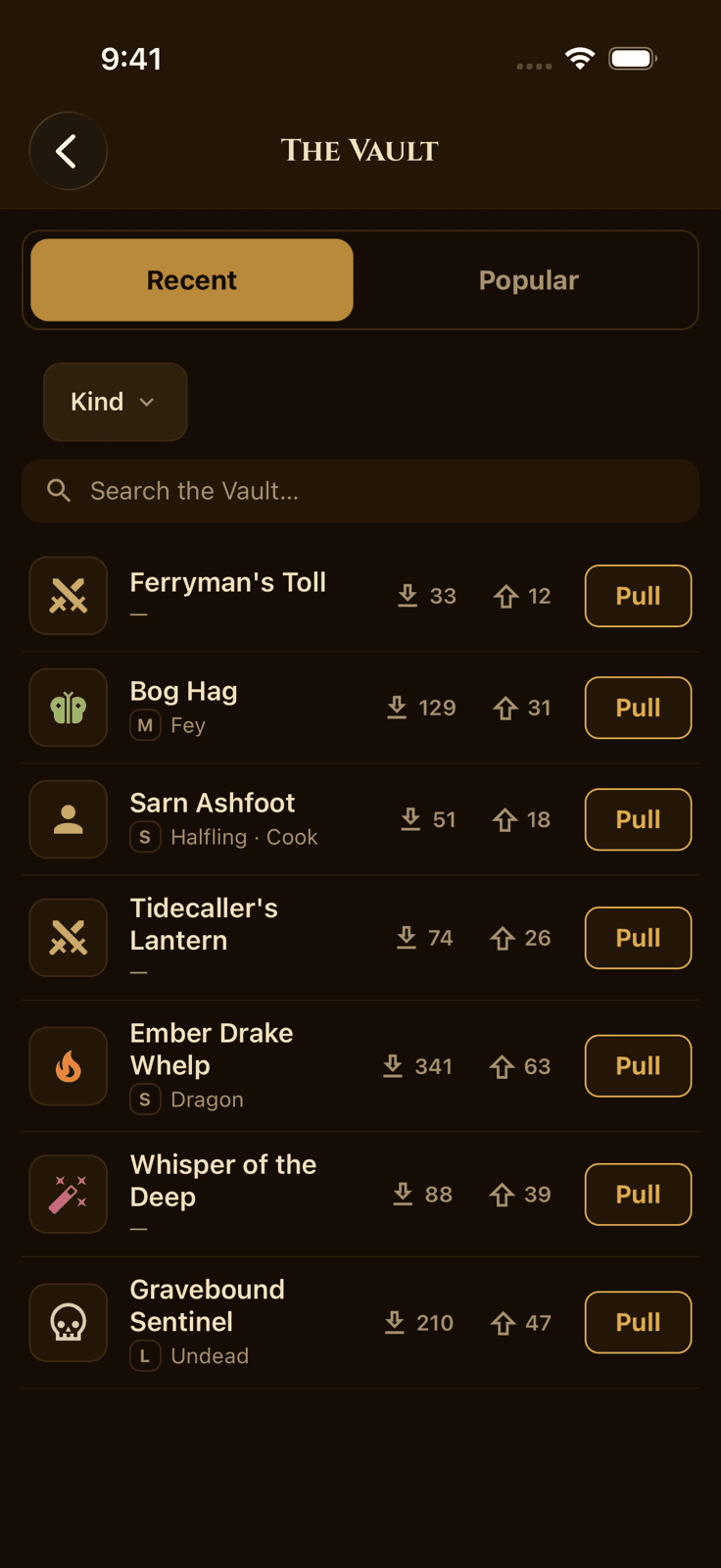
Browse what other Game Masters have made (monsters, NPCs, items, and spells) by kind, newest or most-upvoted first. Read the full stat block and upvote it before anything touches your library. Nothing arrives uninvited.
Publishing is one tap, and dependencies ride along: publish a creature that casts a homebrew spell or swings a homebrew sword, and the spell and the sword travel with it. What you pull is what the author actually ran.
Everything moves as Mythcode (plain YAML any text editor can read), so nothing you make is trapped here. Paste it to a friend, post it in your group chat, or publish it to the Vault; it imports back onto the right shelf either way.
Your free account also backs up the whole library (creatures, items, spells, campaigns, party, and notes), so a new phone is a restore, not a rebuild. Everything else in MythForge works without ever signing in.
The tavern is open
Bring MythForge to your next session
A one-time $9.99 on the App Store: no subscription, no in-app purchases.